Empowering Farmers, Transforming Agriculture.
Empowering Farmers, Transforming Agriculture.

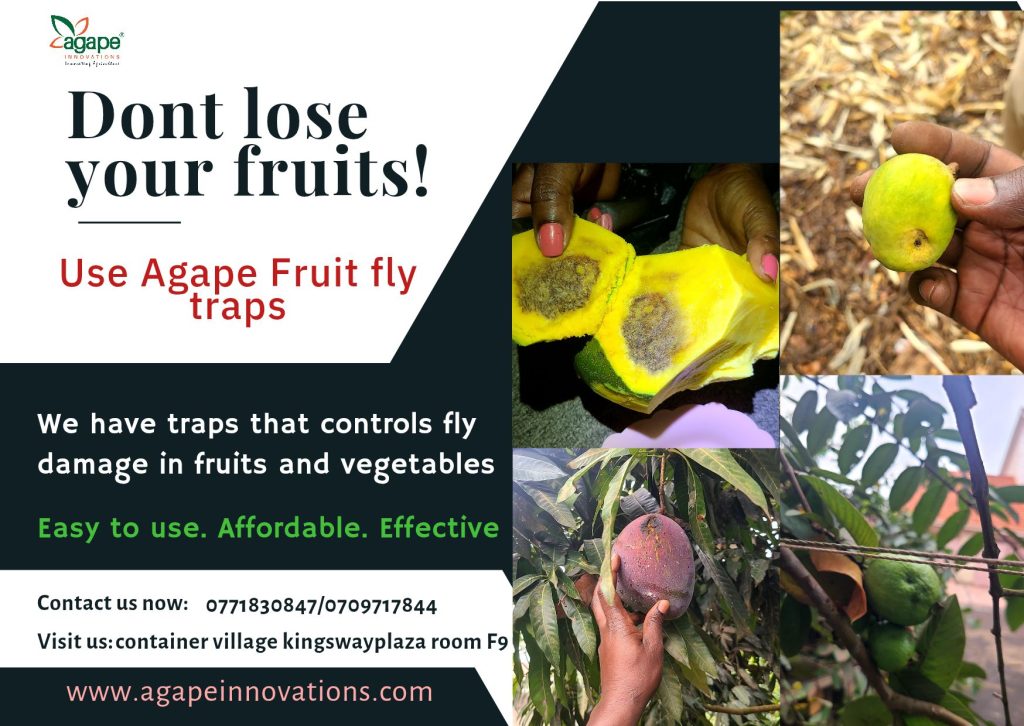
# Fruit Flies Are Small—but Their Appetite Has No Respect for Your Investment!
A mango farmer may spend months pruning trees, controlling diseases, feeding the orchard and waiting patiently for fruit. Then, just as the mangoes begin looking ready for the market, fruit flies arrive like uninvited relatives who somehow know exactly when food is available.
The fruits may develop punctures, soften prematurely or rot. By the time the farmer notices larvae inside a damaged fruit, the attack has already progressed. Fruit flies therefore threaten more than fruit: they can reduce marketable produce, complicate aggregation and undermine access to quality-conscious markets.
## Meet Agape Fruit Fly Lure Blocks
[Agape Fruit Fly Lure Blocks](https://agapeinnovations.com/product/fruit-fly-lures-blocks/) are attractant blocks used inside suitable fruit-fly traps. Agape’s official product information explains that the block is suspended inside the trap using its plastic-string handle.
The lure uses an attractant associated with male fruit flies. Agape’s website identifies methyl eugenol among its fruit-fly lure compounds. Methyl eugenol is especially attractive to male Oriental fruit flies, *Bactrocera dorsalis*, an important pest of mango and several other fruits.
When correctly deployed, the lure draws susceptible male flies into the trap. Trapping can help farmers:
* Detect fruit-fly activity
* Monitor changes in the pest population
* Begin management before damage becomes widespread
* Reduce numbers of targeted male flies where traps are deployed properly
* Evaluate whether orchard-management measures are working
FAO includes methyl-eugenol trapping within integrated fruit-fly management for mango production. However, traps should be combined with orchard sanitation and other suitable practices; they are not a complete programme by themselves. [FAO integrated fruit-fly management guidance](https://sti-portal.fao.org/innovations/crop-protection-integrated-management-fruit-flies)
A trap is an agricultural security officer—not the entire Uganda Police Force.
## Why waiting for damaged fruit is expensive
Adult female fruit flies lay eggs in suitable fruit. The immature stages then develop inside, where ordinary surface spraying may not easily reach them. This is why monitoring and early intervention are more useful than waiting until damaged fruits are already falling.
Fruit flies also do not respect farm boundaries. A clean orchard can face pressure from neglected host trees, abandoned fruit and unmanaged orchards nearby. Where possible, neighbouring farmers should coordinate management rather than each farmer operating as an independent republic.
## Suitable farms and customers
Agape Fruit Fly Lure Blocks may be relevant to:
* Mango orchards
* Guava and mixed-fruit farms
* Commercial fruit producers
* Export-oriented growers
* Fruit cooperatives and aggregators
* Agricultural projects supporting horticulture
* Nurseries and demonstration farms
* Extension teams monitoring fruit-fly populations
The correct lure must match the target pest. Methyl eugenol strongly attracts particular male *Bactrocera* species, but it does not attract every fruit-fly species equally. Farmers should obtain help identifying the pest where the species is uncertain.
A fruit fly may be small, but using the wrong lure against it is like calling a boda boda rider to arrest a thief—the enthusiasm may be present, but the assignment is confused.
## How to use the lure responsibly
Agape’s official instructions state that the block should be inserted into the appropriate trap through the provided slot and suspended using its plastic-string handle.
For better results:
1. **Install traps early.** Begin monitoring before fruit becomes fully mature and highly attractive to flies.
2. **Use a compatible trap.** The lure block must be placed in the trap designed for it.
3. **Follow the current Agape label.** Trap density, positioning and replacement intervals should come from the product instructions or an Agape agronomist.
4. **Place traps where they can be inspected.** Avoid locations where livestock, children or routine farm operations may disturb them.
5. **Record catches regularly.** Note the date, orchard section and approximate number of flies captured. Records are more useful than saying, “There were very many.”
6. **Replace lures as directed.** An old lure should not remain in the orchard merely because it still looks hardworking.
7. **Handle any accompanying pest-control component strictly according to its registered label.** Do not improvise mixtures or application rates.
8. **Dispose of used components responsibly.** Follow the supplier’s instructions and applicable agricultural-waste requirements.
## Traps work best as part of an orchard programme
Fruit-fly management should also include:
* Frequently collecting fallen and visibly infested fruits
* Destroying or treating infested fruit using an approved method rather than throwing it beside the orchard
* Harvesting produce at the appropriate stage
* Removing neglected host fruit where practical
* Pruning trees to make monitoring and harvesting manageable
* Coordinating management with neighbouring orchards
* Using other approved biological, baiting or sanitation measures when recommended by a qualified agronomist
Do not place a trap in a dirty orchard and expect it to perform miracles while hundreds of infested mangoes are holding a fruit-fly conference underneath the trees.
## Protect the marketable fruit before the pest sends an invoice
Fruit-fly management begins with knowing that the pest is present, acting early and maintaining orchard sanitation. Agape Fruit Fly Lure Blocks provide farmers and agricultural programmes with a practical tool for monitoring and managing susceptible male fruit flies within a broader integrated strategy.
Contact Agape Innovations Limited for genuine fruit-fly lure blocks, compatible traps and current guidance on choosing and positioning the correct lure for your orchard.
**Agape Innovations Limited**
**Call/WhatsApp: 0771830747 / 0709717844**
**Catch the pest early—before your mangoes become a free restaurant with branches in every tree.**