
Empowering Farmers, Transforming Agriculture.
Empowering Farmers, Transforming Agriculture.

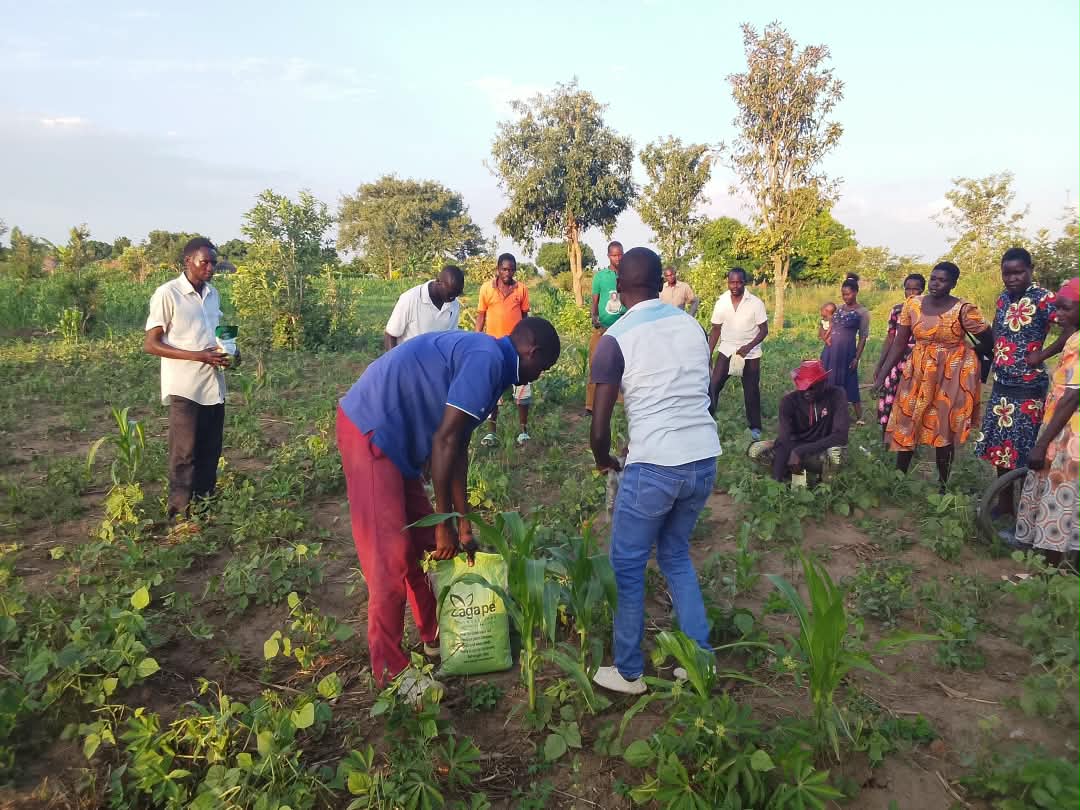
A Ugandan farmer plants soybean on a well-prepared field.
The seed is good. Planting is completed on time. Weeding is planned. The farmer has even warned the goats that the new crop is not a community feeding programme.
But one important partner may still be missing: the correct nitrogen-fixing bacteria.
Soybean, beans and other legumes can form a biological partnership with specialised bacteria called rhizobia. When that partnership works properly, nodules develop on the roots and biological nitrogen fixation becomes possible.
However, the right bacteria must meet the right crop under suitable conditions. The farmer cannot simply plant any legume, add any black powder and instruct nature to “find a way.”
That is where Agape Rhizobia Inoculant becomes relevant.
Agape Innovations Limited’s official soil-products page identifies rhizobia as soil bacteria that form partnerships with legumes such as beans, soybean and peas. Agape also presents its Rhizobia Inoculant as a biological input for legume production. (agapeinnovations.com)
A rhizobium inoculant contains selected living bacteria intended for use with a compatible legume crop. After successful root infection, the bacteria occupy nodules where nitrogen fixation can occur.
The product is not ordinary fertilizer. It does not supply a sackful of nitrogen directly to the crop. It introduces a biological partner intended to help a suitable legume access atmospheric nitrogen through its root nodules.
These bacteria are living organisms. They require correct storage, handling, crop matching and application.
A rhizobium packet may be small, but it is not carrying small responsibilities.
The following is general agronomic information, not a guarantee about the performance of a particular Agape product.
Plants require nitrogen to produce proteins, enzymes, chlorophyll and new growth. Although the atmosphere contains large quantities of nitrogen gas, crops cannot directly use that gas in its ordinary form.
Legumes have a special advantage. When compatible rhizobia infect their roots and form effective nodules, the bacteria can convert atmospheric nitrogen into forms that support plant nutrition. In return, the plant supplies the bacteria with energy.
The International Institute of Tropical Agriculture explains that this biological nitrogen-fixation process occurs inside root nodules. It also emphasizes that rhizobial strains differ in their compatibility with particular legumes. (propas.iita.org)
In other words, the crop and the bacteria must recognize one another.
Using the wrong inoculant is like sending a very qualified teacher to the wrong classroom, in the wrong district, speaking the wrong language. Everybody may be present, but the expected work will not begin.
Successful inoculation places suitable rhizobia where they can contact the germinating seedling.
Rhizobia do not move freely over long distances through the soil. The inoculant must therefore be applied using the method specified for that formulation so the bacteria can reach new root hairs.
Agape should confirm whether its current product is intended for:
Farmers must follow the current label. Instructions for a liquid inoculant, peat powder or granular product are not automatically interchangeable.
Where the correct organisms successfully infect a compatible legume, effective nodules may develop and contribute nitrogen to the crop.
This does not mean the inoculant contains unlimited nitrogen or guarantees that the crop will obtain all its nitrogen biologically. The actual response can be influenced by:
IITA notes that nitrogen fixation can be constrained by unsuitable soil pH, inadequate phosphorus, drought, excessive moisture and extreme temperatures. (propas.iita.org)
The bacteria may be hardworking, but they cannot fix nitrogen while drowning, baking in the sun or sitting inside an expired packet.
Rhizobia inoculation should not be treated as a complete replacement for soil testing and crop nutrition.
A legume field may still require:
The appropriate requirements should be established through soil information and professional recommendations.
Adding rhizobia will not correct severe phosphorus deficiency. Applying phosphorus will not substitute for the correct rhizobia. Good agriculture involves identifying each limitation and giving it the correct answer.
One of the most important facts about rhizobia is their host specificity.
The Government of Saskatchewan’s agricultural guidance explains that different pulse crops require appropriate rhizobial species. A bacterium capable of nodulating one legume may not work effectively with another. (Government of Saskatchewan)
This means farmers should not assume that one inoculant is automatically suitable for:
Before purchasing Agape Rhizobia Inoculant, state the exact crop and variety where known. Ask Agape to confirm that the current product is intended for that crop.
Do not purchase “rhizobium for beans” when the crop is soybean simply because soybean is also called a bean in ordinary conversation. Biology requires more precise paperwork than the village trading centre.
Rhizobial inoculants can lose viability through heat, direct sunlight, unsuitable storage or excessive time after opening.
IITA recommends protecting inoculants from overheating and direct sunlight. It also advises inoculating and planting on the same day where seed treatment is used. (propas.iita.org)
Customers should therefore:
The dashboard of a vehicle is not a biological-input store. It is a small solar cooker with seats.
Commercial seed may already carry fungicides, insecticides or other treatments. Some chemicals and application sequences can reduce the survival of rhizobia.
The correct response is not to guess, wash treated seed or secretly add extra inoculant.
Before mixing anything, tell Agape:
Request written compatibility guidance.
Do not mix Agape Rhizobia Inoculant directly with fertilizers, pesticides, disinfectants or other seed treatments unless the current instructions authorize the combination.
Useful products can still quarrel badly inside one basin.
Some powder inoculants require a sticker to help the bacteria-containing material adhere evenly to the seed. Other formulations may already contain an adhesive or use a different application method.
Agape’s current public information does not establish one universal:
Farmers should obtain these details from the current package label and Agape’s written recommendation.
If a sticker is required, use only the recommended product and quantity. Too little may leave much of the inoculant at the bottom of the container. Too much liquid may produce sticky seed, uneven planting or physical seed damage.
“The mixture looked dark enough” is not a measurement.
After inoculation, keep the seed shaded and plant it according to Agape’s stated time limit.
Do not spread treated seed in direct sunshine while workers finish lunch, repair the planter or wait for transport. Do not prepare tomorrow’s seed today unless the product instructions explicitly permit it.
The soil should also have enough moisture to support germination and bacterial survival. Planting inoculated seed into very dry soil can reduce the opportunity for successful root infection.
Rainfall remains important. Rhizobia have biological abilities, but none has yet been seen carrying a jerrycan to the field.
Farmers should not wait until harvest to investigate whether inoculation worked.
Approximately three to four weeks after emergence—subject to local crop guidance—carefully dig up representative plants from several parts of the field. Do not pull them forcefully because nodules can detach from the roots.
Gently remove the soil and examine the root system.
Look for:
When suitable nodules are cut open, active nitrogen-fixing tissue is commonly pink or reddish inside. White, green or brown interiors may indicate ineffective or inactive nodules. Interpretation should still consider crop stage and local conditions. (Government of Saskatchewan)
Record what is observed:
Field | Crop and variety | Seed source | Inoculant batch | Application rate | Treatment date | Planting date | Soil condition | Nodule check date | Nodule observations | Other inputs | Person responsible
If nodulation is poor, contact Agape or a qualified agronomist. Do not immediately apply an unplanned nitrogen dose without understanding the crop stage, soil result and likely cause of failure.
A farmer using Agape Rhizobia Inoculant for the first time can establish a simple comparison.
Use similar plots with the same:
Apply the inoculant to the treatment plots according to Agape’s instructions and leave clearly marked comparison plots under the normal farm practice.
Measure:
Do not inoculate one plot, add phosphorus, weed it early and plant it beside an untreated plot that the cows visited twice—then announce a scientific conclusion.
That is not a demonstration. It is agricultural storytelling with too many characters.
The product should not be expected to replace:
It also should not be marketed as a guaranteed substitute for every nitrogen decision on every farm.
Inoculation is a biological process. Success depends on living bacteria, a suitable crop and a supportive field environment.
Agape Rhizobia Inoculant may be relevant, subject to crop matching and current technical guidance, to:
Agro-input dealers should learn the storage and application requirements before stocking the product. Selling a living inoculant with the instruction “just mix and plant” is not technical support.
Institutional buyers should request the current product specification, crop compatibility, batch information, storage conditions, expiry details, safety guidance and quality documentation.
Legume farmers should not depend entirely on whatever bacteria happen to be present in the field.
Agape Rhizobia Inoculant provides a practical biological option for introducing selected rhizobia to compatible legume crops. Its responsible use begins with identifying the crop, selecting the correct formulation, protecting the living bacteria and applying the product exactly as instructed.
Before purchasing, tell Agape the crop, variety, seed quantity, acreage, location, planting date, seed-treatment status and available soil information. Request the current label, verified application rate, sticker instructions, storage requirements and compatibility guidance.
Agape Innovations Limited
Call/WhatsApp 0771830747 / 0709717844
Your soybean may be ready to work, but it still needs the correct partner underground. Match the crop, protect the bacteria and let every nodule report for duty.
