
Empowering Farmers, Transforming Agriculture.
Empowering Farmers, Transforming Agriculture.

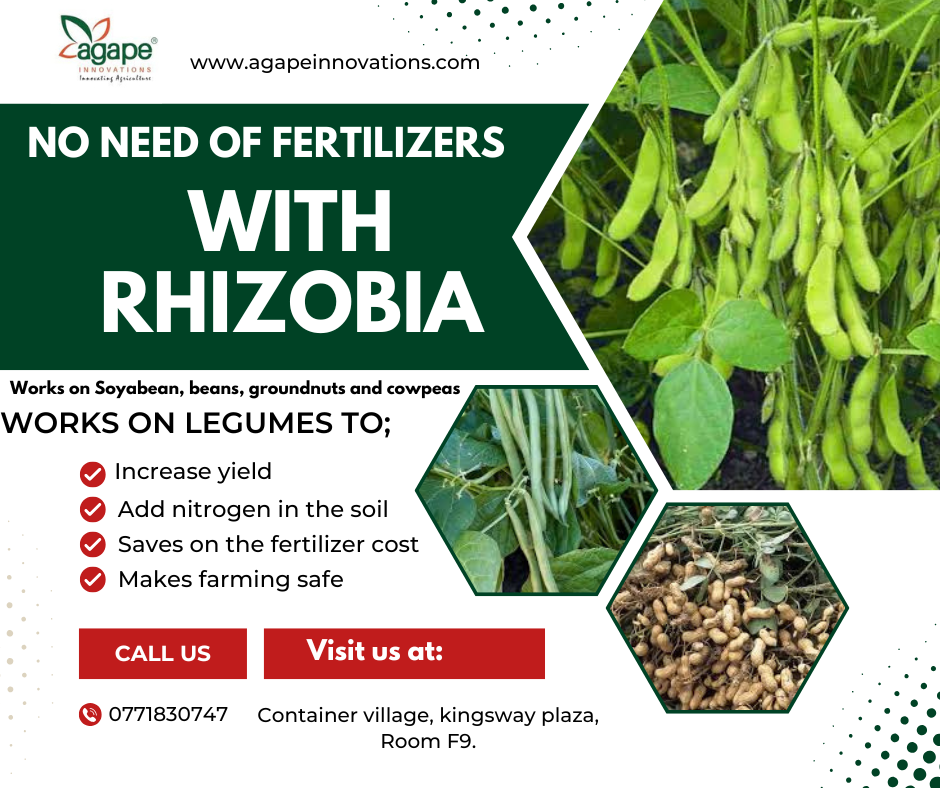
In Uganda’s growing agricultural sector, maximizing yield while reducing input costs is every farmer’s goal. One proven and affordable way to achieve this is by using Rhizobia inoculants—a powerful biological tool that improves nitrogen fixation in legume crops like soybeans, groundnuts (gnuts), and beans.
At Agape Innovations Limited, we are proud to be a leading supplier of high-quality, certified Rhizobia inoculants specifically formulated for Uganda’s soils and climate. Whether you’re a smallholder, commercial farmer, cooperative, or agro-input dealer, Rhizobia should be part of your planting plan.
Rhizobia are naturally occurring soil bacteria that form a symbiotic relationship with legume crops. When applied to seed before planting, Rhizobia colonize the plant’s roots and form nodules—small structures that convert atmospheric nitrogen into forms the plant can use.
This process, known as biological nitrogen fixation, significantly reduces the need for chemical nitrogen fertilizers, improves crop health, and enriches the soil for future use.
Most Ugandan soils lack sufficient populations of the right Rhizobia strains, especially in areas where legumes have not been grown regularly. Inoculating your seed ensures that your crops get the right type and quantity of Rhizobia bacteria from the start.
Soybeans have one of the highest nitrogen demands among legumes, yet they are often planted in depleted soils. Using Rhizobia inoculants on soybean varieties—especially improved ones like Maksoy 3N and Maksoy 6N—ensures:
When Rhizobia is used correctly, soybean yields can increase by 30% to 60%, and farmers save significantly on fertilizer costs. For commercial producers and farmer cooperatives targeting processing or export markets, Rhizobia is a critical input.
Groundnuts are widely grown across Uganda, yet many farmers fail to realize their full yield potential. This is largely due to poor nodulation caused by insufficient native Rhizobia in the soil. Using the correct strain of Rhizobia inoculant for groundnuts results in:
Inoculation is particularly important when growing groundnuts in rotation with cereals like maize, or in newly opened land where legumes haven’t been planted before.
Beans are a staple crop in Uganda, grown in both seasons across highlands and lowlands. While beans can nodulate with native Rhizobia, studies show that supplementing with effective Rhizobia strains leads to:
Agape Innovations supplies Rhizobia strains specifically suited for common beans, ensuring farmers get the best response regardless of region or soil type.
Agape Innovations is not just a distributor—we are an agricultural development partner with years of experience supporting farmers and agrodealers across Uganda. When you buy Rhizobia from us, you get:
Our products are suitable for use by NGOs, farming projects, commercial farms, and individual growers looking to boost their productivity sustainably.
Application is simple and farmer-friendly:
Note: If you also need to treat seed with pesticides or fungicides, do it first. Let the seed dry before applying Rhizobia. Never mix chemicals and Rhizobia at the same time.
To get the best from your Maksoy soybeans, your SERENUT groundnuts, or your NABE bean varieties, make sure you start with the right Rhizobia.
Contact Agape Innovations Limited today to place your order and receive expert support on application and crop management.
Contact Information:
Phone: 0771830747/0709717844
Email: agapeinnovationslimited@gmail.com
Website: www.agapeinnovations.com
Visit us: Container village, kingsways F9, Kampala Uganda.
