
Empowering Farmers, Transforming Agriculture.
Empowering Farmers, Transforming Agriculture.

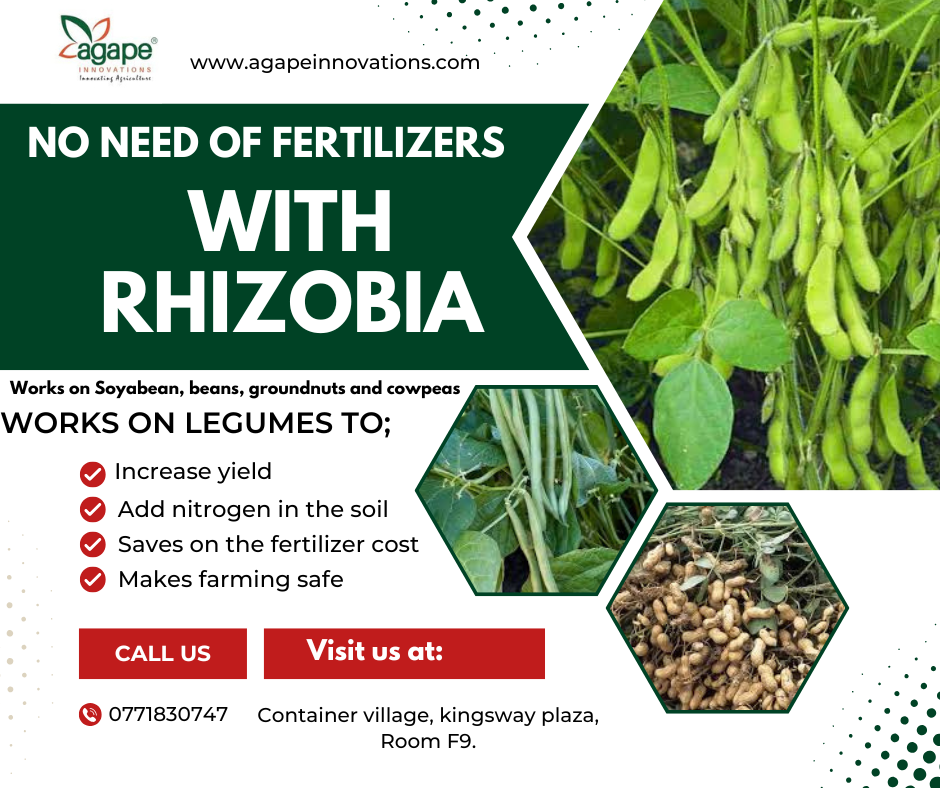
Modern agriculture demands solutions that increase yields, reduce production costs, and protect soil health. Rhizobia inoculants offer a scientifically proven, environmentally friendly, and highly cost-effective alternative to synthetic nitrogen fertilizers in legume production systems.
Rhizobia are naturally occurring, beneficial soil bacteria that form a symbiotic relationship with legume crops such as:
When applied correctly to seed or soil, Rhizobia infect the roots of the legume plant and form specialized structures called nodules. Inside these nodules, the bacteria convert atmospheric nitrogen (N₂) into ammonia — a form of nitrogen that plants can absorb and use for growth.
This biological process is called Biological Nitrogen Fixation (BNF).
In simple terms:
👉 The plant feeds the bacteria with sugars.
👉 The bacteria feed the plant with nitrogen.
👉 Both benefit — and the farmer profits.
Nitrogen fertilizer is often the most expensive input in crop production. Rhizobia can fix between 50–300 kg of nitrogen per hectare, depending on:
This dramatically reduces or even eliminates the need for chemical nitrogen fertilizers.
For smallholder and commercial farmers alike, this means:
Effective inoculation results in:
Where soils lack effective native Rhizobia populations, yield increases of 15–40% or more are common with proper inoculation.
One of the greatest advantages of Rhizobia is its long-term impact on soil health.
After harvesting the legume crop:
This makes Rhizobia ideal for:
It supports sustainable productivity, not just short-term gains.
Rhizobia inoculants are:
They reduce:
For farmers targeting organic certification or regenerative agriculture, Rhizobia is an essential input.
Rhizobia interaction stimulates:
This enhances crop resilience under:
Important: Each legume requires a specific Rhizobium strain for maximum effectiveness. Using the correct strain is critical.
Ensure the product matches the specific legume crop.
Compared to chemical nitrogen fertilizers:
| Parameter | Chemical Nitrogen | Rhizobia |
|---|---|---|
| Cost per hectare | High | Very low |
| Soil health impact | Can degrade soil | Improves soil |
| Environmental impact | High carbon footprint | Eco-friendly |
| Long-term benefit | Short-term | Residual benefits |
Return on investment (ROI) is significantly higher with proper inoculation.
Rhizobia is not just a fertilizer.
It is a biological productivity enhancer, a soil health restorer, and a profit maximizer.
We are located in Container village, Kingsway Plaza, Room F9, Kampala Uganda. Or you can call us on 0771830747, 0709717844, 0200910171.
