
Empowering Farmers, Transforming Agriculture.
Empowering Farmers, Transforming Agriculture.

the role of microorganisms in the garden
A Ugandan farmer can inspect workers in the garden.
The person weeding is visible. The one spraying is visible. Even the neighbour’s goat entering through the weak part of the fence is very visible.
But some of agriculture’s most important workers are too small to see.
Beneficial microorganisms can interact with plants, leaves, roots and nutrients. When conditions are suitable, selected microbes may support processes involved in plant nutrition and development. When they are absent, poorly handled or introduced under unsuitable conditions, the expected benefit may not appear.
This is where biological crop inputs require both opportunity and discipline. A bottle containing living microorganisms should not be treated like ordinary coloured water.
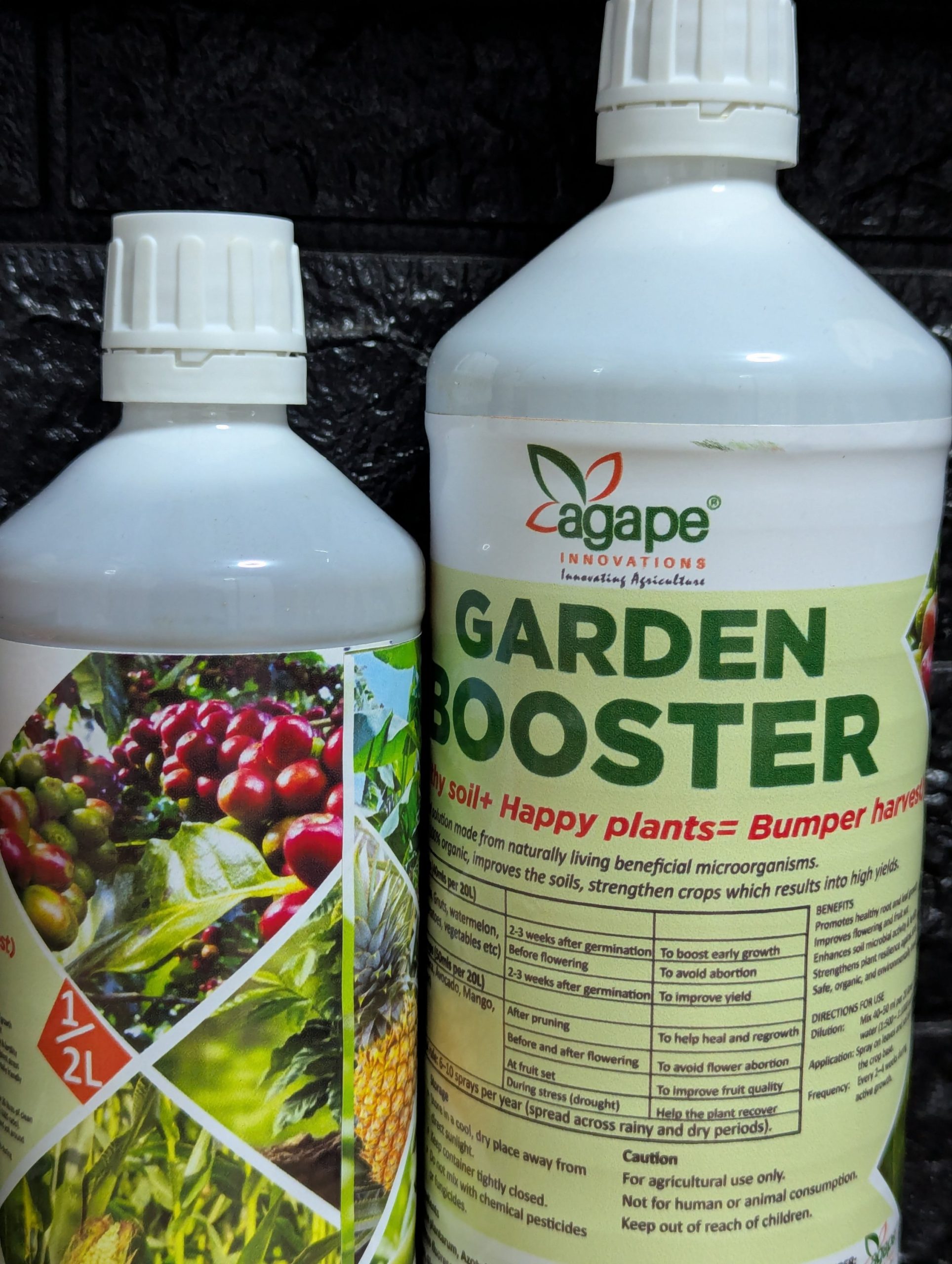
According to Agape Innovations Limited’s current product page, Agape Garden Booster is a biological foliar fertilizer formulated with beneficial bacteria.
Agape’s published description identifies:
The product is intended for application as a foliar spray. Agape presents it as a biological input designed to support plant nutrition, root development, nutrient use and crop vigour. Agape Innovations
These are Agape’s published product claims. They should not be interpreted as a guarantee of a particular yield, profit, disease-control result or response in every field.
Biology does not read marketing brochures. Performance still depends on the crop, formulation, microbial viability, application method, weather, soil, water, nutrition and general field management.
The following is general agronomic information—not proof of how Agape Garden Booster will perform on a particular farm.
A microbial agricultural input contains living organisms selected for particular biological functions. Different microorganisms may interact with crops in different ways. Depending on the organism and the conditions, potential functions can include:
However, microbial products are not universally predictable.
Alabama Cooperative Extension explains that biological inoculants carry living organisms, making temperature and humidity during transport and storage important. Its 2026 field research also found that crop responses varied across products, locations and seasons. Soil properties, weather and existing microbial communities influenced performance. The researchers recommend local, side-by-side testing before wide commercial adoption. Read the Extension guidance. Alabama Cooperative Extension System
That is a useful lesson for farmers: biological inputs should be evaluated carefully, not worshipped and not dismissed.
Agape Garden Booster’s main distinguishing feature is its microbial formulation.
Rather than supplying only conventional soluble nutrients, it introduces selected bacteria intended to support biological activity associated with the crop. This may be useful to farmers seeking to incorporate biological inputs into an existing nutrition programme.
The product should not automatically be treated as a complete replacement for fertilizer, manure, lime or other diagnosed requirements. Farmers should first establish what the crop and soil actually need.
A microbial input cannot manufacture phosphorus that does not exist, correct severe soil acidity by negotiation or irrigate a dry garden using good intentions.
Agape identifies Garden Booster as a foliar product. Foliar application places the spray on crop leaves rather than relying entirely on soil placement.
The FAO explains that foliar fertilizers are diluted and sprayed over plant foliage, but the appropriate method depends on the crop, product and weather. It also warns that compatibility must be confirmed before combining foliar nutrients with pesticides. See FAO’s integrated plant-nutrition guidance. fao.org
For Agape Garden Booster, customers should follow Agape’s current label rather than borrowing instructions from another foliar fertilizer or microbial product.
Agape states that Garden Booster can complement conventional and organic farming programmes.
“Complement” is the important word.
A responsible programme may still require:
Garden Booster should enter a managed crop system. It should not be asked to rescue every mistake committed before the sprayer arrived.
Agape’s official page lists Garden Booster for a broad range of crops, including:
This published list indicates possible crop suitability, not one universal application programme.
Coffee seedlings, mature mango trees, tomatoes and maize differ greatly in leaf area, growth stages, spray coverage and nutrient requirements. Customers should therefore request crop-specific guidance.
A microbial product can lose value before application if it is transported or stored incorrectly.
Before purchasing, check:
Do not leave the product in direct sunlight, beside a hot iron-sheet wall or inside a closed vehicle unless the label explicitly permits those conditions.
A living microorganism cannot shout, “Boss, this dashboard is too hot.” It simply stops reporting for duty.
Agape’s public webpage does not provide enough verified information to publish one universal application rate, dilution ratio, spray interval or water volume.
Before spraying, ask Agape to confirm:
Use clean water and equipment according to the label. A sprayer previously used for herbicides, disinfectants or other chemicals may contain residues that could damage the crop or affect living organisms.
Clean does not mean “the operator rinsed it quickly and said it looked fine.”
Farmers often combine several products to reduce labour. The tank may contain foliar fertilizer, pesticide, fungicide, sticker and whatever remained in an unlabelled bottle at the store.
That can create incompatibility, crop injury or reduced biological activity.
Do not mix Agape Garden Booster with:
unless Agape’s current written guidance confirms compatibility.
Two products being useful separately does not mean they will cooperate inside the same knapsack sprayer. Even good agricultural inputs can hold a very bad meeting.
Application conditions influence foliar products.
As general practice, farmers should consider:
The exact weather limits and rain-free period must come from Agape’s current instructions.
Avoid assuming that doubling the concentration will compensate for poor weather or missed applications. Excess concentration can waste the product and may injure crops.
“More” is not a scientifically recognized application rate.
Because biological performance can vary among soils, crops and seasons, commercial farmers should consider a simple comparison before adopting the product widely.
Divide a reasonably uniform area into:
Keep other practices as similar as possible. Record:
Field | Crop and variety | Planting date | Garden Booster batch | Rate | Spray date | Crop stage | Weather | Other inputs | Observations | Harvest results
Where possible, use several repeated strips rather than one treated corner and one untreated corner.
Compare measurable observations such as:
Do not spray Garden Booster on one field, add manure to another, change the variety, plant on different dates and then announce that one visible difference has proved everything.
That is not a trial. It is a farming debate in which every participant changed the subject.
Agape Garden Booster should not be expected to replace:
It also should not be presented as a cure for an unidentified disease or nutrient deficiency.
If a crop is yellow, stunted or wilting, investigate the cause. The problem could involve nitrogen, acidity, waterlogging, drought, root damage, disease, insects, compaction or several limitations operating together.
The correct product applied to the wrong problem remains the wrong decision.
Subject to crop-specific recommendations, Garden Booster may interest:
Institutional customers should request the current product specification, safety information, batch documentation, storage requirements and technical instructions before procurement.
Dealers should also understand that a microbial product requires correct storage and customer guidance. It should not be placed on a hot shelf and sold with the instruction, “Just mix something and spray.”
Agape Garden Booster offers farmers a biological foliar input containing selected beneficial microorganisms. Its practical value begins with the correct crop, viable product, responsible storage, accurate dilution and suitable application conditions.
It works best as part of a complete crop-management programme—not as a substitute for diagnosis, nutrition, water and field discipline.
Before purchasing, provide Agape with the crop, acreage, growth stage, current condition, other inputs being used and available spraying equipment. Request the current label, application rate, storage conditions, compatibility guidance, safety instructions and recommended spray schedule.
Agape Innovations Limited
Call/WhatsApp 0771830747 / 0709717844
Your farm already employs people you can see. Agape Garden Booster introduces workers you cannot see—but like every good workforce, they still need the right job, proper conditions and competent management.
