
Empowering Farmers, Transforming Agriculture.
Empowering Farmers, Transforming Agriculture.

Are drying coffee twigs hiding a black coffee twig borer problem? Learn how Agape’s trap supports early monitoring and integrated management in Uganda.
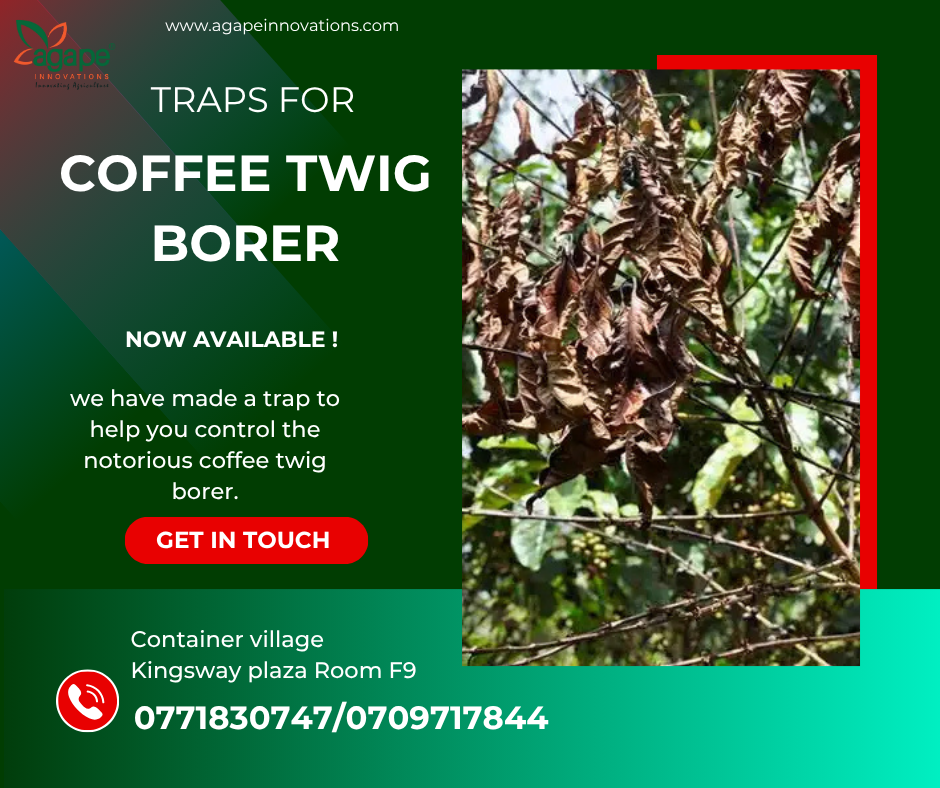
One coffee branch turns yellow. Another dries from the tip. By lunchtime, three people have offered three explanations: sunshine, disease, and a neighbour who admired the garden too confidently. Before coffee management becomes a village debate, inspect the evidence.
For Ugandan coffee growers, a tiny entrance hole can point to a serious hidden problem. The black coffee twig borer spends much of its life inside the twig, so the farmer may notice wilting and drying only after damage has begun. That makes regular scouting and adult-beetle monitoring especially useful.
The black coffee twig borer, Xylosandrus compactus, attacks coffee branches. Uganda’s Ministry of Agriculture lists early signs that include yellowing leaves and tiny entrance holes, often on the underside of an affected branch. Darkening, wilting and drying can follow. These signs deserve investigation, but one dry twig alone is not a complete diagnosis.
Uganda’s National Agricultural Research Organisation explains why this pest is difficult to manage: it hides inside the coffee stem, where a late response may arrive after the branch has already been damaged. NARO reports that both Robusta and Arabica can be attacked, with Robusta more heavily affected.
The practical question is therefore not, “Can I wait until many branches dry?” It is, “How can I notice adult beetle activity early enough to inspect the field and act intelligently?”
The current Agape Innovations catalogue lists the Coffee Twig Borer Trap as a baited monitoring and capture tool for coffee fields. Its bottle-style setup uses an Agape lure in a small dispenser and soapy water in the trap body. The lure attracts flying adult beetles; beetles entering the trap are caught in the water.
That gives the grower something visible to count. A catch does not automatically measure every beetle in the garden, but records from several positions can show where and when adult activity is being detected. This helps the farmer decide where to scout more closely and when to seek crop-specific advice.
The distinction matters: the trap can help monitor and capture adults moving through the field. It cannot repair an already damaged twig, prove that every drying branch has the same cause, or guarantee that a coffee garden will remain pest-free. It belongs inside an integrated management routine.
Product-specific instructions matter. For the current Agape trap, the catalogue gives the following working routine:
A simple record can have five columns: date, trap location, beetles caught, nearby symptoms and action taken. “Trap near the lower slope” is far more useful than “somewhere behind the coffee.” Your future self is a busy person; give that farmer proper notes.
A trap should send you back to the crop, not replace crop inspection. Walk the rows, check the underside of suspicious twigs for small holes, and compare trap catches with what you see on nearby plants. Mark problem areas so the team can return to the same locations.
The Uganda Ministry of Agriculture’s black coffee twig borer advisory recommends combining trapping with measures such as regular field inspection, removal and proper destruction of infested plant material, pruning and de-suckering, suitable shade management, clean planting material, and attention to soil fertility and moisture. Ask an agronomist or extension worker to help confirm the problem and the appropriate local response.
This combined approach is important because the trap catches beetles outside the twig, while sanitation addresses infested material already in the field. One tool cannot do every job. Even a good hoe does not also keep farm records.
Neighbouring growers can also compare observations. A beetle does not stop at a boundary because your land title is in order.
When contacting Agape, share your district, coffee type, acreage, approximate age of the coffee, symptoms observed and current management practices. Clear photos of affected branches can help the conversation, although field diagnosis may still be necessary.
Ask about current availability, the complete trap and lure components, placement for your field layout, maintenance, lure replacement and price. Rates and availability can change, so get the current guidance rather than relying on an old message forwarded through six WhatsApp groups.
The coffee twig borer prefers quiet work. A maintained trap, a weekly field walk and a clear record make that secrecy harder. Once the beetle lands in a monitored trap, it has finally signed the attendance book.
Learn more about Agape’s Coffee Twig Borer Trap and other practical farm solutions, or contact the Agape team in Kampala for product-specific guidance.
Agape Innovations Limited
Call/WhatsApp 0771830747 / 0709717844
