Empowering Farmers, Transforming Agriculture.
Empowering Farmers, Transforming Agriculture.

# Your Legumes Need the Right Friends Underground—Meet Agape Rhizobia Powder
A soybean farmer may prepare the land carefully, plant good seed and weed on time, yet the crop remains pale and unenthusiastic. The farmer then blames the rain, the soil, the seed supplier—and eventually the neighbour who admired the garden too loudly.
But another possible problem is happening underground: ineffective nodulation.
## The small partnership that feeds a legume
Legumes such as soybean, beans, groundnuts, cowpeas and peas require nitrogen for healthy growth. Certain rhizobia bacteria can form nodules on legume roots and convert atmospheric nitrogen into forms the plant can use.
The arrangement is a genuine biological partnership: the plant supplies carbohydrates to the bacteria, while the bacteria help provide usable nitrogen. It is one of agriculture’s finest agreements—completed without lawyers, stamps or a meeting at the district headquarters.
However, rhizobia are crop-specific. A strain suitable for soybean may not be appropriate for beans or groundnuts. Fields where a particular legume has not been grown recently may also lack enough compatible and effective bacteria.
The [TAAT Africa technology catalogue](https://e-catalogs.taat-africa.org/com/technologies/seed-inoculation-with-rhizobia), updated on 3 July 2026, explains that inoculation introduces suitable rhizobia to the seed, supporting root nodulation and biological nitrogen fixation.
## Introducing Agape Rhizobia Powder
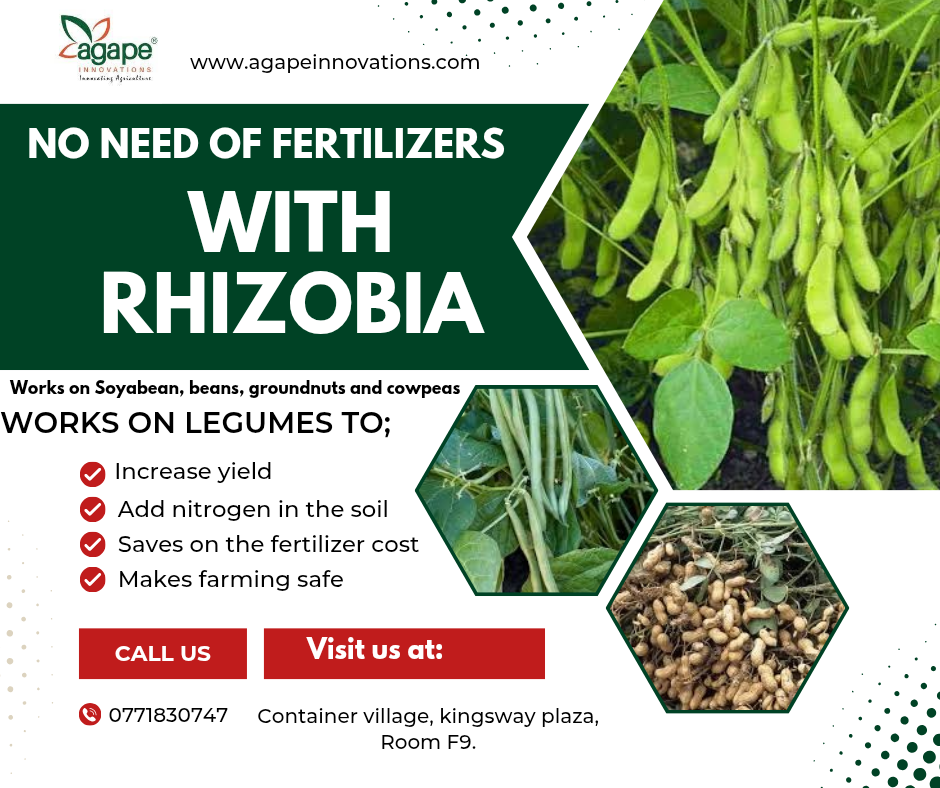
Agape Rhizobia powder is a biological inoculant supplied by Agape Innovations Limited for legume production. Agape’s official information identifies soybean, beans and groundnuts among the relevant crops.
The inoculant is applied so that suitable living bacteria are placed close to the germinating seed and developing roots. When crop, strain, soil and environmental conditions are compatible, these bacteria can establish nodules and support biological nitrogen fixation.
This does not mean inoculation guarantees a particular harvest. Results can be influenced by inoculant quality, crop compatibility, soil acidity, phosphorus availability, moisture, temperature, seed treatments, storage and planting practices.
Rhizobia are living workers. If you roast them in the sun before planting, do not later complain that the staff failed to report for duty!
## Why farmers should consider inoculation
### It supports biological nitrogen fixation
Proper nodulation helps legumes obtain nitrogen through their partnership with compatible rhizobia. This makes inoculation particularly worth considering when introducing a legume to a field for the first time or returning it after a long absence.
### It can complement better soil management
Rhizobia do not replace every nutrient. Legumes still require suitable soil conditions and adequate nutrients, particularly phosphorus where deficient. Severely acidic soil, drought, waterlogging and poor seed quality can limit performance.
### It is suitable for farmers of different sizes
Agape Rhizobia Powder may be relevant to:
* Soybean, bean and groundnut growers
* Cowpea and other legume farmers, subject to strain confirmation
* Farmer cooperatives and seed-distribution programmes
* Commercial farms
* Agro-dealers
* NGOs promoting soil fertility and food security
* Institutions conducting legume demonstrations
## Treat living inoculants with care
Rhizobia are not ordinary powder. Their value depends on living microorganisms reaching the seed and root zone in good condition.
Farmers should:
1. Confirm that the inoculant is suitable for the exact legume being planted.
2. Check the label, expiry date and condition of the package.
3. Store it according to the label, protected from excessive heat and direct sunlight.
4. Follow Agape’s current product instructions for the correct seed quantity, sticker and mixing method.
5. Coat the seed gently and evenly using clean equipment.
6. Keep inoculated seed away from direct sunlight.
7. Plant it promptly—preferably on the same day it is inoculated.
8. Confirm compatibility before combining the inoculant with chemically treated seed, pesticides or fertilizers.
9. Avoid mixing rhizobia directly with granular fertilizer unless the product instructions expressly permit it.
A farmer should never invent an application rate because “the powder looked too little.” With biological products, adding more by emotion is not a scientific method.
## Give your legumes the right underground team
Good seed is important. Good soil management is important. Rainfall matters. But when compatible rhizobia are missing, a legume may be trying to perform an important job without the right partner.
Before planting soybean, beans, groundnuts or another legume, contact Agape Innovations Limited for the appropriate rhizobia product and current application guidance.
**Agape Innovations Limited** We are located in container village, Kingsway plaza, room F9.
**Call/WhatsApp: 0771830747 / 0709717844**
**Help the roots form the right partnership—because even crops grow better when they network wisely.**