
Empowering Farmers, Transforming Agriculture.
Empowering Farmers, Transforming Agriculture.

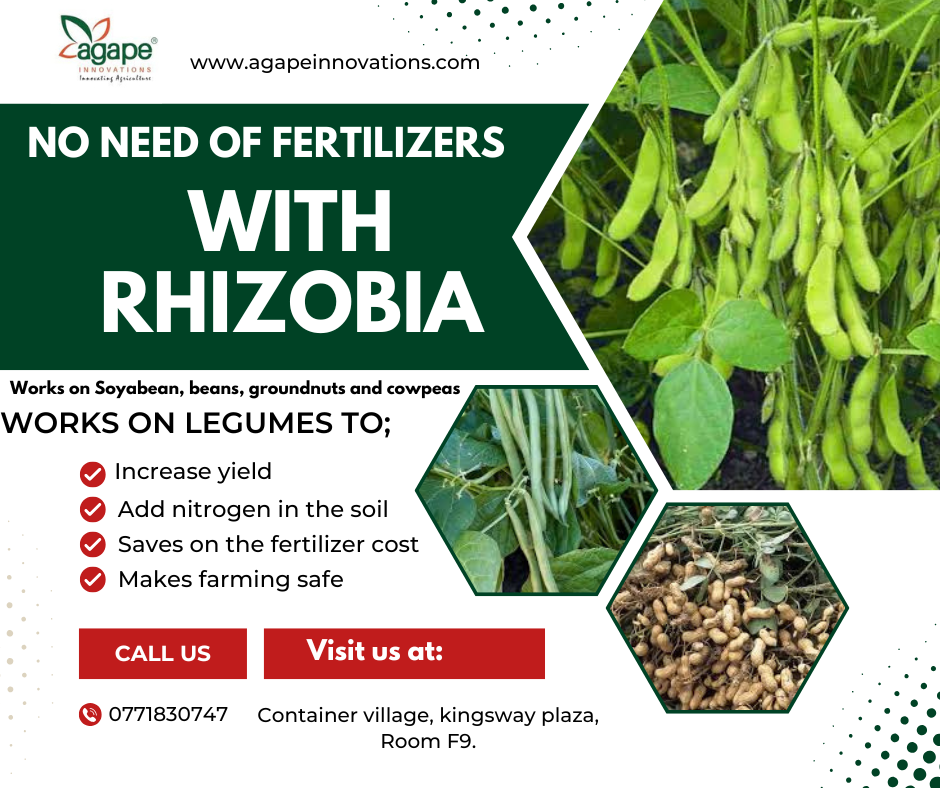
In Uganda and across East Africa, farmers are constantly looking for ways to improve crop yields while cutting production costs. Fertilizers are often expensive, and poor soils make farming even more challenging. But what if you could feed your crops without buying large amounts of nitrogen fertilizer — while also improving your soil year after year?
The answer lies in Rhizobia — nature’s nitrogen-fixing champions.
Rhizobia are friendly soil bacteria that live in partnership with legume plants such as beans, soybeans, groundnuts, cowpeas, and pigeon peas. When you treat your seeds with rhizobia before planting, these bacteria attach to the plant’s roots and form small swellings called nodules. Inside these nodules, the rhizobia work like tiny nitrogen factories — pulling nitrogen from the air and converting it into a form the plant can use.
This natural nitrogen supply keeps your plants well-fed all season, without relying heavily on costly synthetic nitrogen fertilizers.
Using rhizobia is simple, but proper handling is important for best results:
Rhizobia are not just another input — they are an investment in your soil and your future yields. By using them, you get bigger harvests, save money, and improve your land for the next generation.
Whether you are a smallholder farmer planting a few acres or a commercial producer managing hundreds of hectares, rhizobia can transform your legume production into a profitable, sustainable enterprise.
This planting season, give your crops the gift of nature’s own fertilizer. Use Rhizobia — grow more, spend less, and build your soil for years to come.
📍 Available now at Container Village, Kingsway Plaza, Room F9.
📞 For bulk orders, farmer training, and technical advice, call 0771830747.
