
Empowering Farmers, Transforming Agriculture.
Empowering Farmers, Transforming Agriculture.

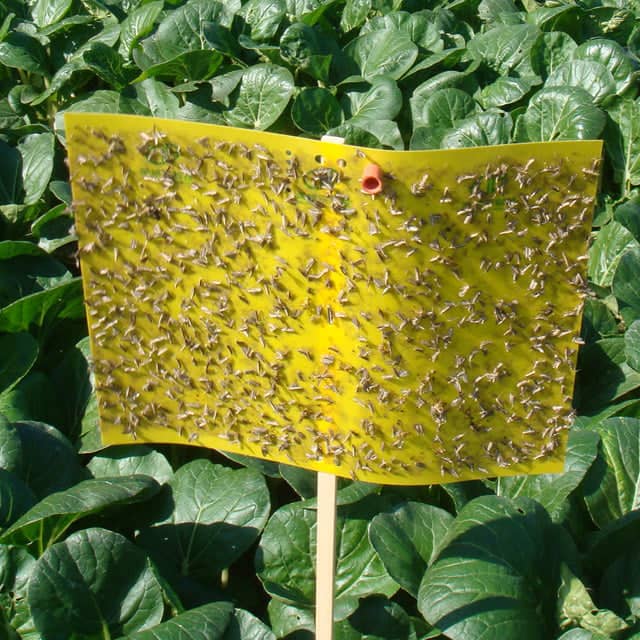
In modern farming, pests are no longer just a seasonal inconvenience—they are a constant threat to yield, quality, and profit. Among the most silent yet destructive pests are whiteflies, aphids, leaf miners, thrips, and fungus gnats. These small insects multiply quickly, spread plant diseases, and weaken crops before a farmer even notices the damage.
One of the simplest, most cost-effective, and chemical-free solutions to monitor and control these pests is the yellow sticky trap.
Yellow sticky traps are bright yellow cards or sheets coated with a strong adhesive that attracts and captures flying insect pests. The color yellow is highly attractive to many agricultural pests because they mistake it for young leaves or flowers.
Once the insects land on the surface, they get stuck and cannot escape.
Most pest infestations are only noticed when damage is already severe. Sticky traps act like an early warning system by capturing pests before they multiply.
Farmers can quickly identify:
With proper monitoring, farmers avoid unnecessary spraying. This means:
Sticky traps help farmers spray only when necessary, not on guesswork.
Unlike sprays that work for a limited time, sticky traps work 24/7. They continuously reduce pest populations by capturing adults before they lay eggs.
Yellow sticky traps are non-toxic and do not harm crops, soil, or pollinators when used correctly. They are ideal for:
No technical training is required. Farmers simply:
They are especially effective in crops such as:
Using yellow sticky traps leads to:
In short, they help farmers save money while earning more.
For best results, yellow sticky traps should be used as part of an Integrated Pest Management (IPM) system together with:
They are not a replacement for all pest control—but they dramatically reduce dependence on chemicals.
In today’s competitive agriculture, success is about precision, not excess. Yellow sticky traps give farmers control, visibility, and confidence in pest management without heavy chemical reliance.
If you are serious about protecting your crops and improving profitability, this small tool can make a big difference in your farming system. Contact us in container Village, Kingsaway plaza, room F9. Call us on 0771807 or email us on www.agapeinnovations.com
